Essay — The Battle of Lepanto, 7 October 1571
In the Sala dello Scrutinio — the hall where Venetian senators used to cast their votes for the election of the doge — there is a painting that stops you in your tracks. It is The Battle of Lepanto by Andrea Vicentino (Andrea Michieli, c. 1539–1614).
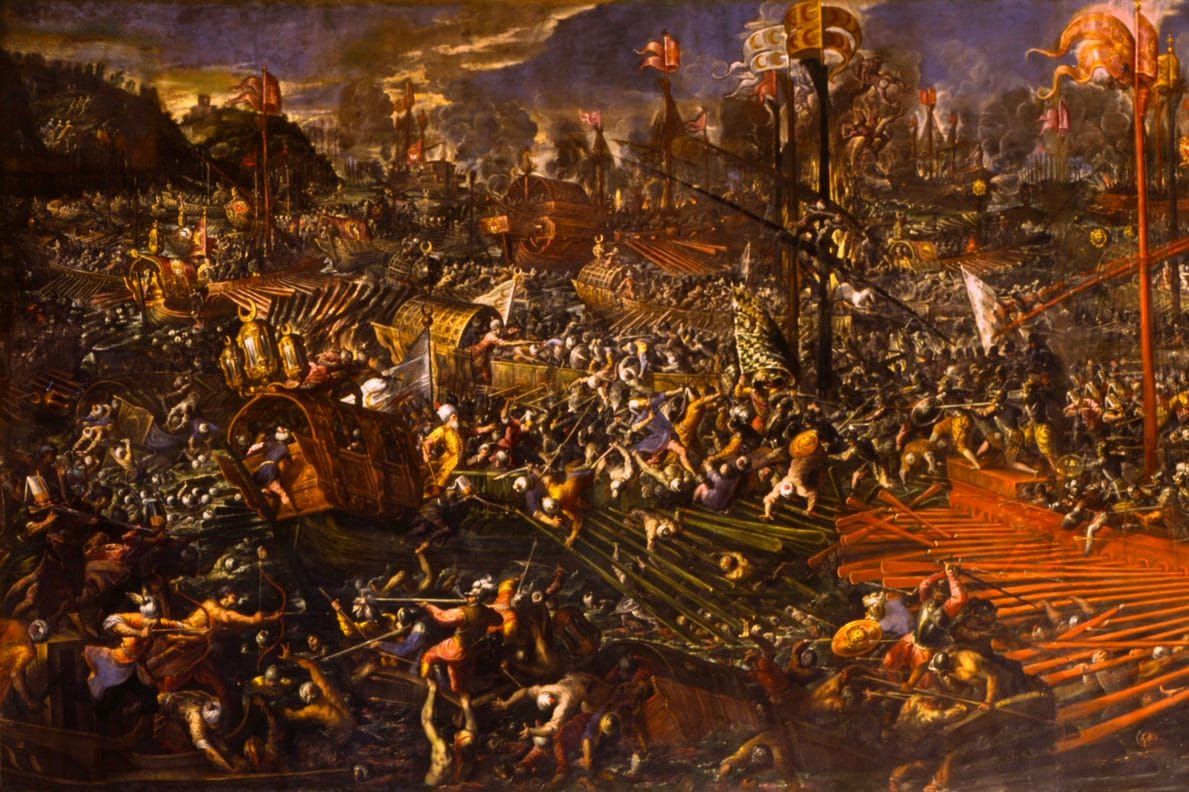
Vicentino, a Venetian painter of the late Mannerist period and a favourite pupil of Palma il Giovane, was one of the artists brought in after the terrible fire of 1577, which destroyed most of the palace's original decoration, including an earlier version of this same subject painted by Paolo Veronese. His canvas is enormous and packed with ships, smoke, and bodies — galleys locked together, cannon fire tearing through hulls, the standard of the Holy League somewhere in the middle of all the chaos. It is worth standing in front of it for a while.
What happened
On 7 October 1571, at the mouth of the Gulf of Corinth, the two largest fleets in the Mediterranean came face to face. On the Ottoman side: 222 galleys, 60 smaller vessels, 750 cannon, around 88,000 men, under the command of Ali Pasha. On the other side, the fleet of the Holy League — Venice, the Pope, Spain, Genoa, Savoy, Malta and others — led by Don Juan of Austria, illegitimate son of Charles V and half-brother to Philip II of Spain. He was twenty-four years old.
The real backbone of the Christian fleet was Venetian, and the most important Venetian contribution was six galeazze — a new type of heavy warship, broader and more heavily armed than a galley, with armoured sides, an iron ram at the prow, and between them 1,815 cannon. These six ships went ahead of the rest of the fleet before the battle began. Around midday they opened fire, and the Ottoman centre fell into disorder before a single boarding action had taken place.
Five hours later it was over. Nearly 29,000 Ottoman dead, 10,000 wounded, 8,000 captured; 80 galleys sunk or burned, 140 taken. The Christian side lost 7,656 dead — 4,856 of them Venetian — and 7,784 wounded.
Sebastiano Venier
The Venetian commander was Sebastiano Venier, one of the most extraordinary — and most difficult — figures in the Republic's history. He was born in 1496, which means he was in his mid-seventies at Lepanto, an age at which most people, then as now, had long since stopped doing anything particularly demanding. Venier had not. During the battle he reportedly refused to stay below and fought with a crossbow from his own deck, somewhere between inspiring and simply unstoppable. Before the battle he had a furious argument with Don Juan of Austria over his unauthorised hanging of some Spanish soldiers who had mutinied — a row that nearly broke the alliance apart before it had even been tested.
After Lepanto, Venier went on to become doge in 1577, at eighty-one. He held the office until his death in 1578 and is buried in Santi Giovanni e Paolo, where his monument can still be seen. For a significant part of his life he lived near Santa Maria Formosa, in Castello, and a commemorative plaque on a building in that neighbourhood still marks the connection. It is a quiet corner of Venice, easy to walk past without noticing — which is of course one of the best reasons to look for it.
Why it mattered
Lepanto was the culmination of a period of real fear for Venice. That same year, Cyprus had fallen to the Ottomans after a siege of extraordinary violence — the defender of Famagosta, Marcantonio Bragadin, was publicly flayed alive after surrendering under a guarantee of safe conduct, his skin stuffed with straw and paraded through the streets. The Republic had watched the Ottoman Empire absorb Constantinople, Belgrade, Hungary, and much of the eastern Mediterranean over the previous hundred years. Lepanto did not reverse all of that — Cyprus was never recovered — but it broke the myth that the Ottoman fleet could not be beaten on open water.
For Venice it was also, in a way, the last great moment of the old maritime empire. The losses were heavy, the alliance with Spain did not last long, and Cyprus stayed Ottoman. But on that October afternoon, for five hours off the Greek coast, the Venetians fought what felt — and was declared to be — the defence of the Christian world. The day of Santa Giustina was immediately made a permanent public holiday.