
Essay —The Room of the Four Doors
Along the walls, large canvases tell the story of the Republic’s history and key moments. Below them, the marble doors, with finely carved capitals, are crowned by sculptural groups — twelve statues in total.
The room quietly shows its purpose — a meaning shaped by centuries. Four doors, four entrances. On its own, the room reflects the constant movement of people that has always defined Venice — yesterday as much as today. Three doors seem to reach toward the sea, like the lagoon’s three openings, while the fourth opens toward the mainland. In this way, the room acts as a miniature Venice.
As you look around, another detail stands out. Female figures appear everywhere — calm, strong, and majestic. Each of them represents the same figure: Venice herself, the Queen of the Seas.
The Ceiling
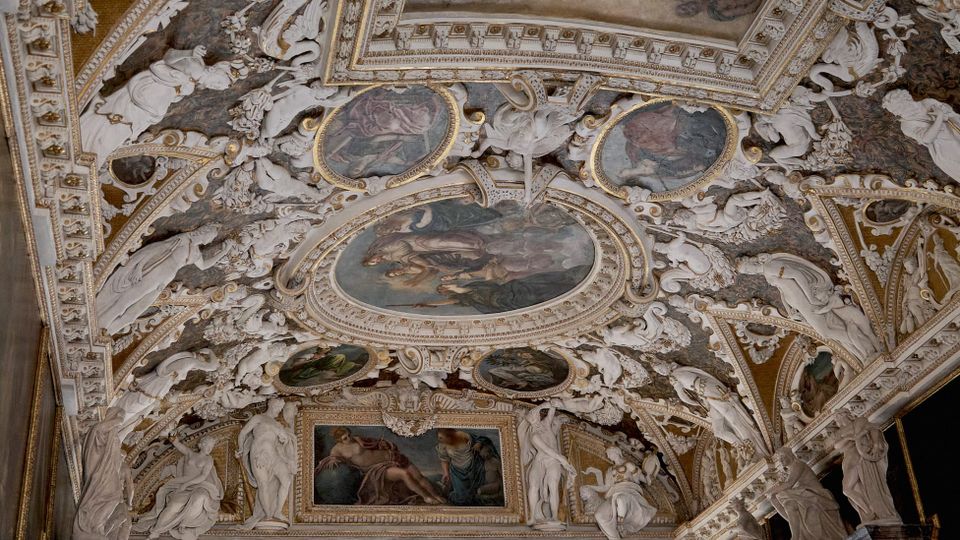
During the fire of 12 May 1574, this hall and part of the palace were destroyed. The architect Antonio da Ponte, following drawings by Andrea Palladio and Antonio Rusconi, oversaw its reconstruction. The ceiling was executed by Giovanni Cambi, known as il Bombarda, while the grotesque motifs were carved by Maestro Baldissera.
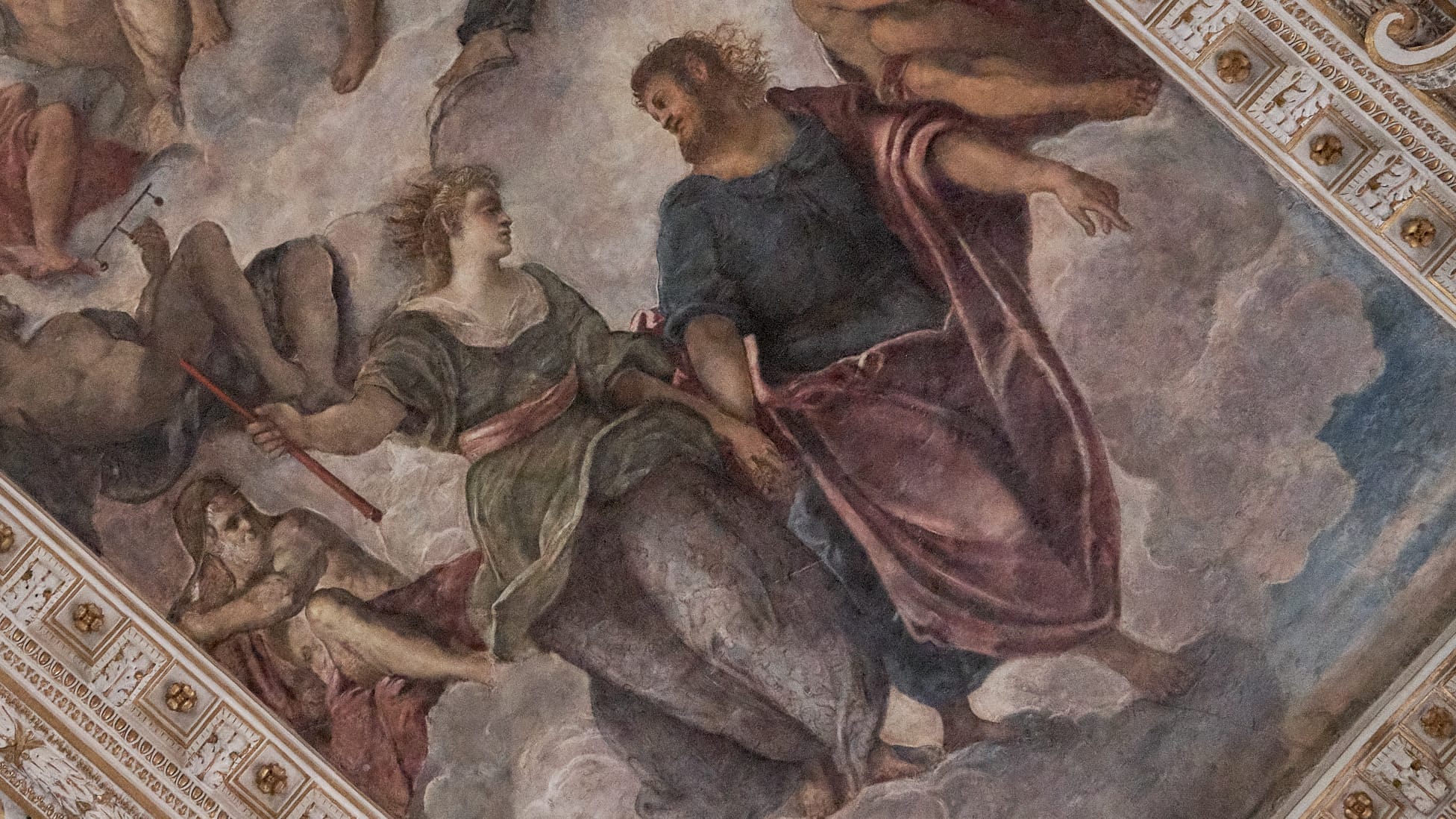
The ceiling forces the visitor to look up, almost instinctively, in search of wonder and reverence. At the centre, in Tintoretto’s fresco, Venice receives her mission from Jupiter, who gestures downward toward the islands of the lagoon. The city’s foundation is shown as something desired and approved by an entire pantheon of gods.
Mars and Neptune appear, along with Minerva and Mercury. Venice already holds the staff of command. It matters little that the original fresco was later altered, in 1713, by Nicolò Bambini, when Jupiter was transformed into Saint Mark with the addition of a halo. The message remains unchanged.
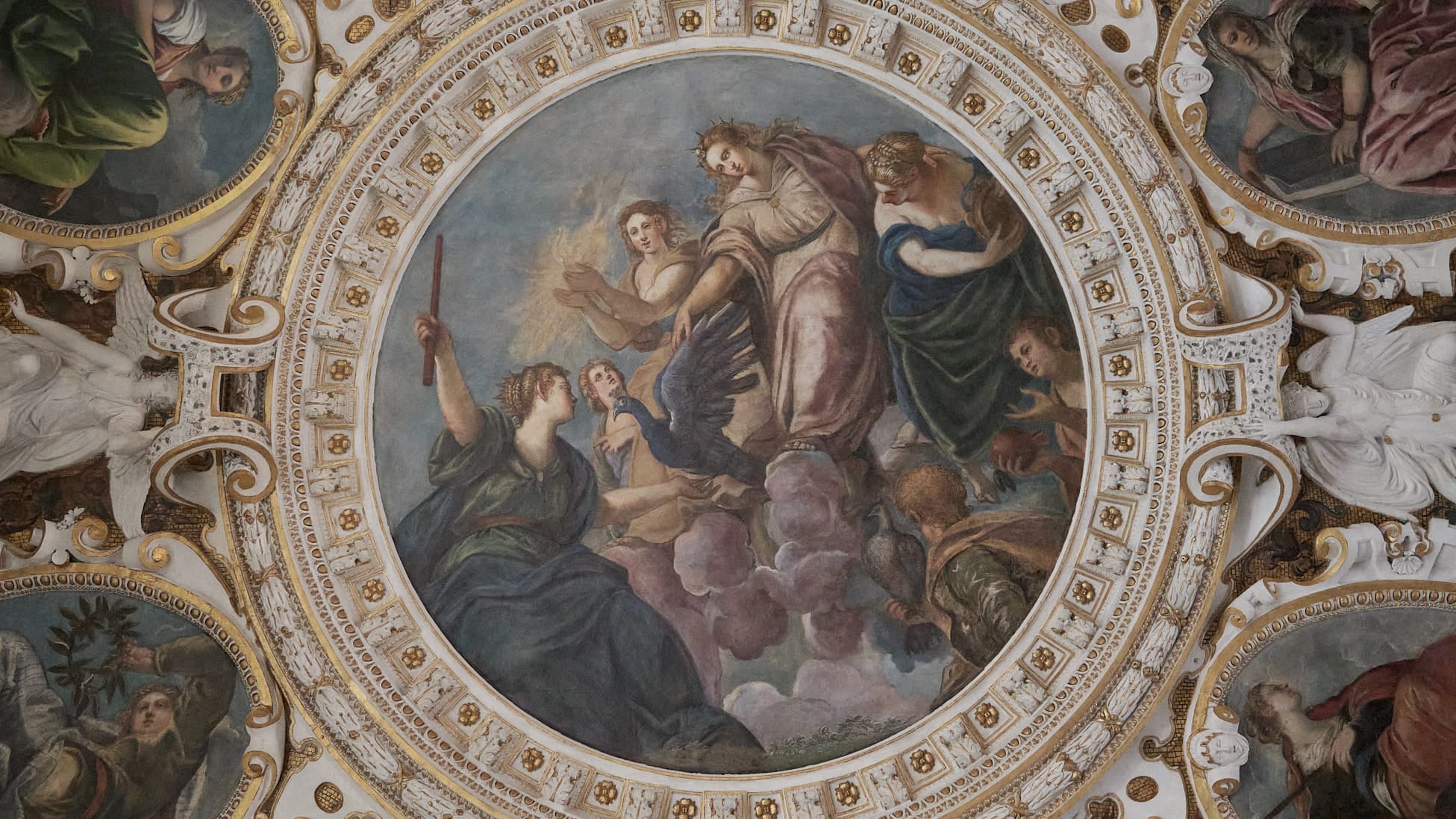
Nearby, two other frescoes reinforce the idea of Venice’s noble origin. Juno offers the peacock, a symbol of elegance and dignity, along with the thunderbolt, a sign of power and authority. Venice is always shown as a crowned queen, holding the sceptre high in her raised hand.
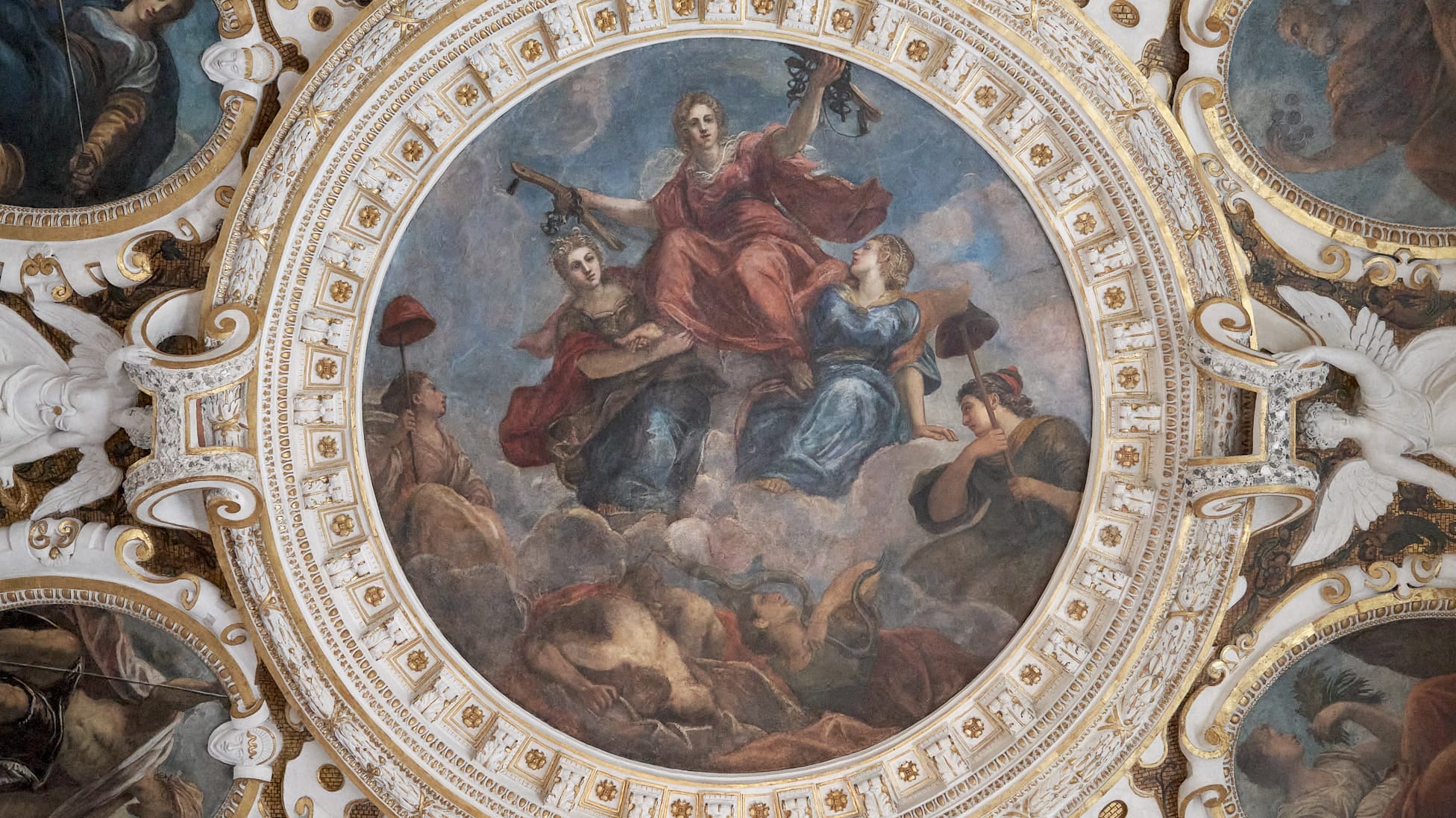
On the opposite side, another roundel fresco by Tintoretto shows Venice holding broken chains — a clear sign of a city born free, never conquered. She is accompanied by two virtues: Fortitude and Prudence.
At the sides, two young women lift long staffs topped with the pileus, the Roman cap given to freed slaves. It was a symbol of freedom then, and it would return centuries later as the Phrygian cap during the French Revolution. In Delacroix’s famous painting, Marianne wears the same emblem.
Below, three defeated figures lie on the ground. They represent vice, overcome and pushed aside. Among them, the coils of a serpent — a simple image of evil, subdued.
Across the ceiling, eight oval frescoes appear between the main scenes, arranged in a balanced, almost rhythmic way. They personify cities and territories once under the rule of the Republic.
All were originally painted by Tintoretto, though some were later reworked by Nicolò Bambini. The figures represent Verona seen with the arena, Padua surrounded with books, Brescia completely armed, Istria crowned, Friuli putting the sword into the sheath, Treviso with unsheathed sword, Vicenza and fruits, and Altino with archaeological fragments — a quiet map of Venice’s mainland and maritime reach, translated into images.
In the smaller roundels, figures of lawgivers and philosophers look on, suggesting that power here is not only military, but also legal and intellectual.
The Doors
The four doors themselves were designed by Palladio. Above each entrance, sculptural groups introduce the function of the room beyond, using allegory as a form of orientation.
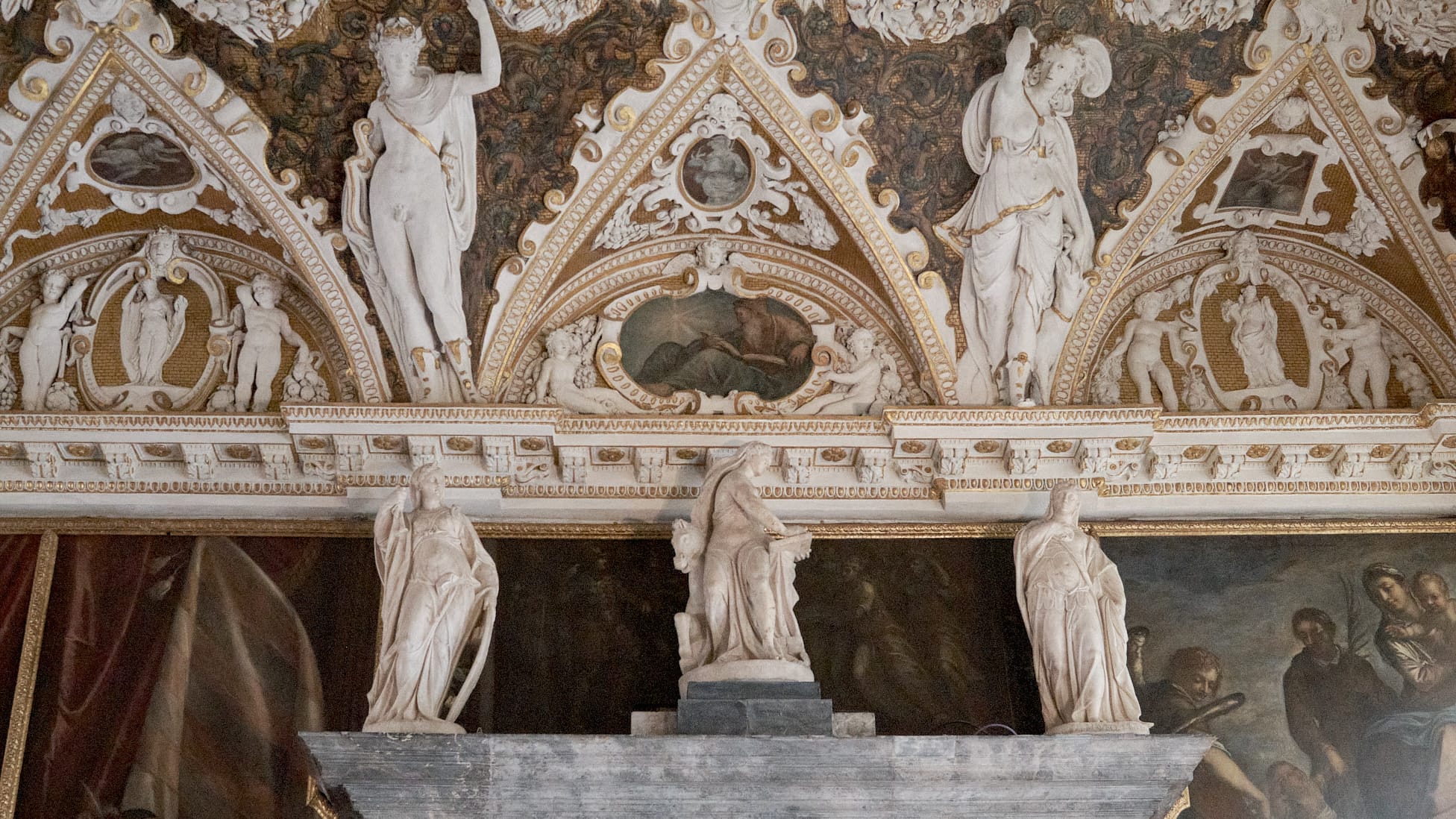
The door leading to the Square Atrium — and from there to the Chancellery — is decorated with sculptures by Giulio del Moro. Here we find Secrecy, wrapped in a cloak that conceals her body; Fidelity, holding a double flute; and Diligence, shown with pen and parchment. Together, they evoke a world of documents, discretion, and careful administration.
The door that opens toward the Chamber of the Council of Ten carries sculptures by Francesco Castelli. Religion wears a crown of stars; Justice holds the fasces; Authority stands with a sceptre. These figures reflect the gravity of this institution, where matters of state security and internal order were decided.
The Senate door is framed by works by Girolamo Campagna. War appears armed and alert; Pallas Athena represents devotion to the arts and reason; Peace holds an olive branch and cornucopia. The balance between conflict, wisdom, and reconciliation mirrors the Senate’s role in foreign policy and diplomacy.
Finally, the door leading toward the Collegio is decorated by Alessandro Vittoria. Eloquence is marked by the moon and the caduceus, the winged staff with entwined serpents; Vigilance is accompanied by a rooster; and Fluency of speech is symbolised by a hawk and wings. These are the virtues of persuasion, attention, and political communication.
Each door, in this way, prepares the visitor for what lies ahead. Before entering the rooms of power, one passes through a language of stone.